|
Institute for Liberal Arts PhD Internships
|
| |
|
This past summer, we had a great group of Institute for Liberal Arts PhD student interns who contributed to DS projects. Among them, Natalie Hill worked with Antonio on scanning objects housed in the Catholic Religious Archives and Burns Library, Khalil Sawan cleaned crucial geographic data for Dr. Andrei Guadarrama's Mexico City project, and Munir Paviwala and Duygun Ruben turned a 19th-century Boston police ledger housed in Burns into a contextualized dataset that can be accessed online. |
| |
|
DH Certificate Capstone Projects
|
| |
|
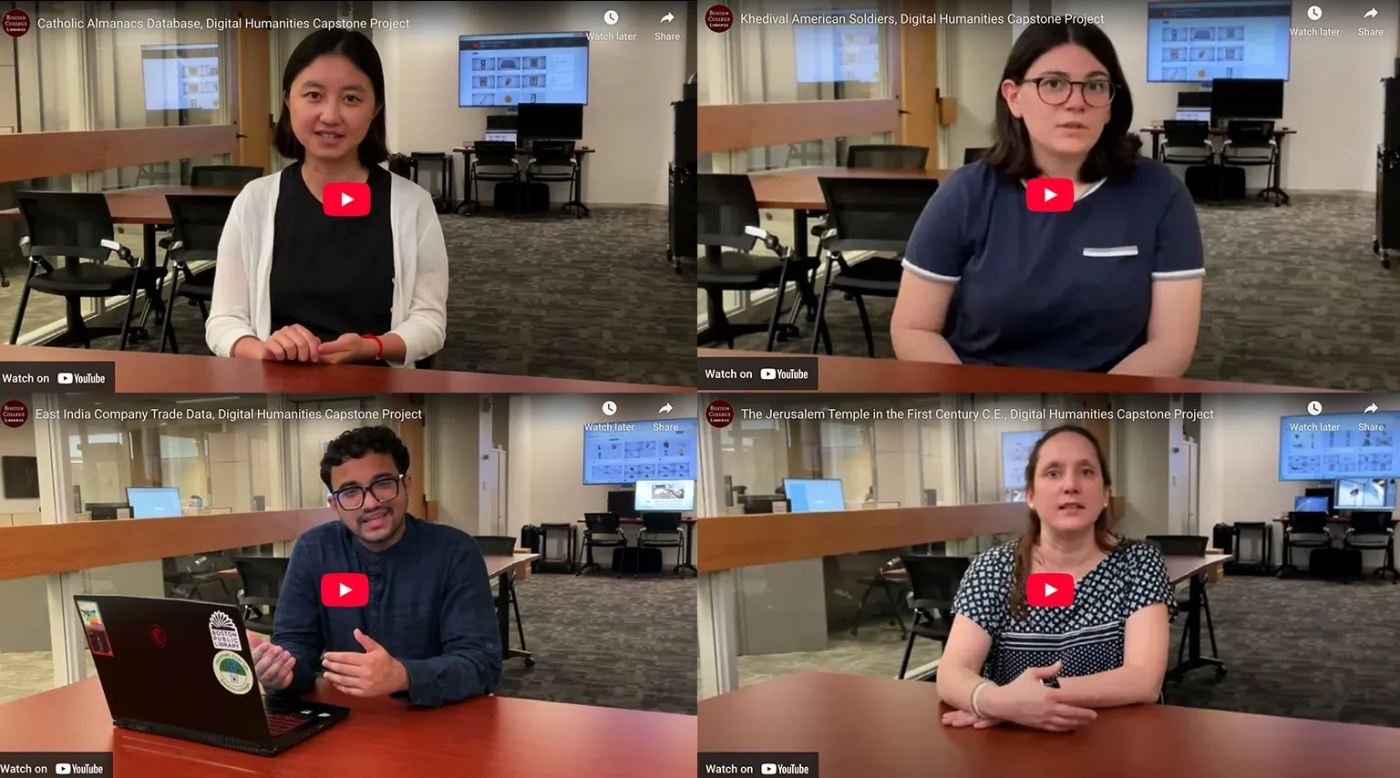
We are delighted to share the spring 2025 DH Certificate capstone projects. From 3D models of the Jerusalem Temple to a Khedival American Soldiers digital collection and network visualization to a database created to search 19th-century Catholic Almanac data, the projects represent a wide range of methodologies and skill sets students gained during their time in the DH certificate program. |
| |
|
DH Capstone Project Talks
|
| |
|
This summer, we recorded some of our students discussing their 2024 and 2025 capstone projects, in which they explain what they did, how they did it, and what they gained from the experience. These videos are great introductions to DH and demonstrate many of its possibilities. You can watch them on the DH certificate website, where you will find additional information about the program as well as DH teaching and learning resources. |
| |
|
Mexico City Urban Development
|
| |
|
Joanna and Antonio are collaborating with Andrei Guadarrama, Visiting Assistant Professor in History and Social Science, on a project related to his 20th-century Mexico City urban development research. Dr. Guadarrama brought us a dataset of El Universal newspaper advertisements for apartments, spanning from 1920 to 1960, and inquired about how he could use it to identify trends in development at the neighborhood level within the city. Currently, we are in the process of cleaning the dataset to prepare it for analysis, and we will soon provide training for his student workers to georeference historic maps of Mexico City. |
| |
|
Catholic Research Archives 3D Scanning
|
| |
|
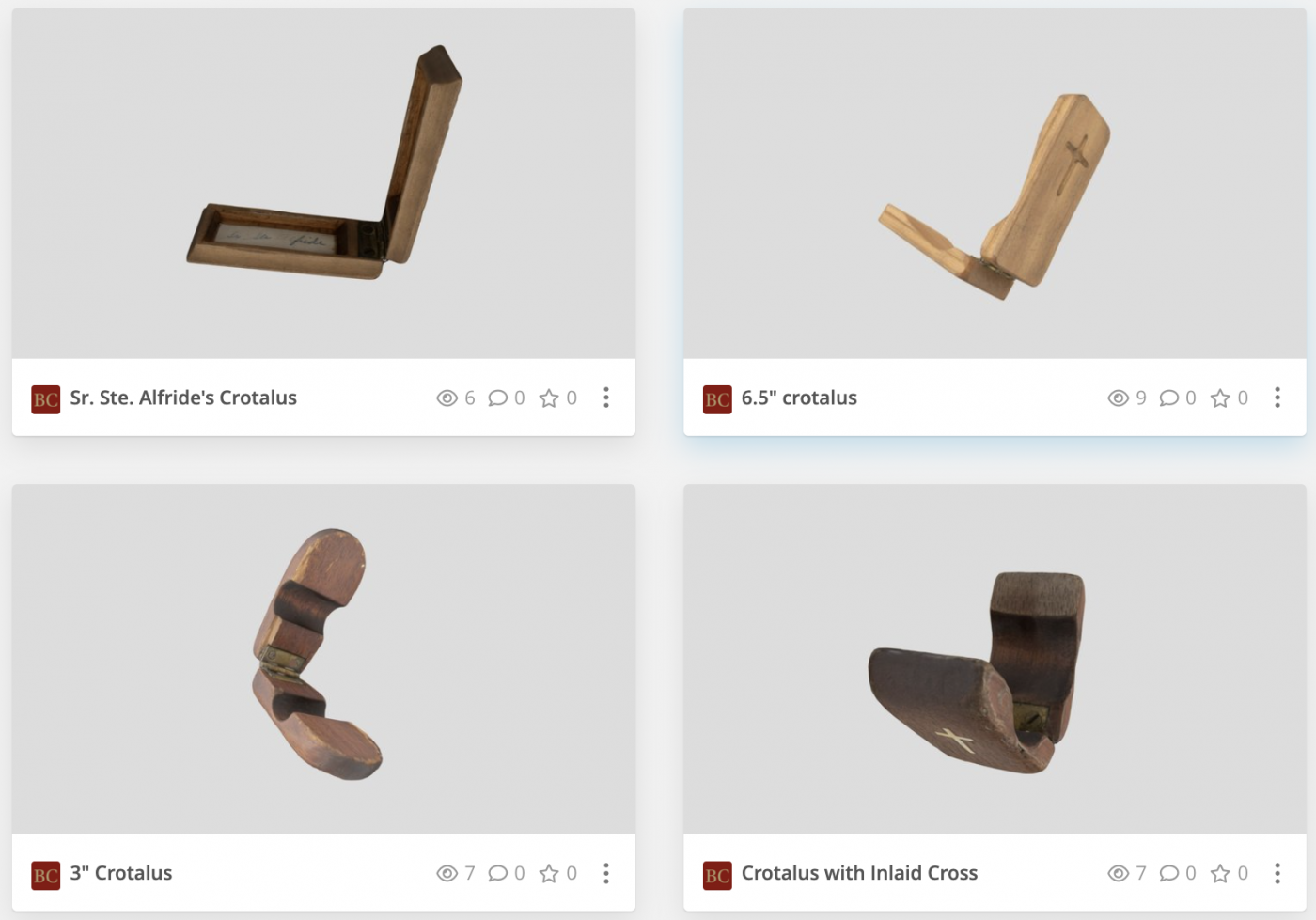
We have partnered with the Catholic Research Archives to produce 3D models of objects from their rapidly growing collections. The models are created through photogrammetry and structured light scanning with assistance from graduate student Natalie Hill and undergraduate Caleb Lee, who have learned to use these technologies to produce highly detailed scans of complex objects. Some early examples include equipment for making and maintaining habits, a tabernacle once installed in the White House, and a collection of personal crotali (clappers used in place of bells during Holy Week). These digital models will be integrated into our soon-to-be-launched online 3D collections repository and pedagogical modules that will introduce a broad student audience to life in the Catholic Church. For now, a selection of these models can be viewed on Sketchfab. |
| |
|
Crotala from the Catholic Research Archives collection |
| |
|
Our "almanac students," as we affectionately call them, were hard at work this summer, extracting and structuring 19th-century Catholic almanac data that will be made accessible and searchable in a database. English PhD student Justin Brown-Ramsey and rising History senior Kate Goldfarb encoded institutions from the start of the almanacs' run (1834-1838), while undergraduates Gabriel Margolies, Kaitlyn Bell, Louisa Bagot, Curran Schestag, Lucy DeMeo, and Leo King worked on the period from 1864 to 1870. All told, the students encoded well over 10,000 institutions under Ashlyn’s supervision and leadership. |
| |
|
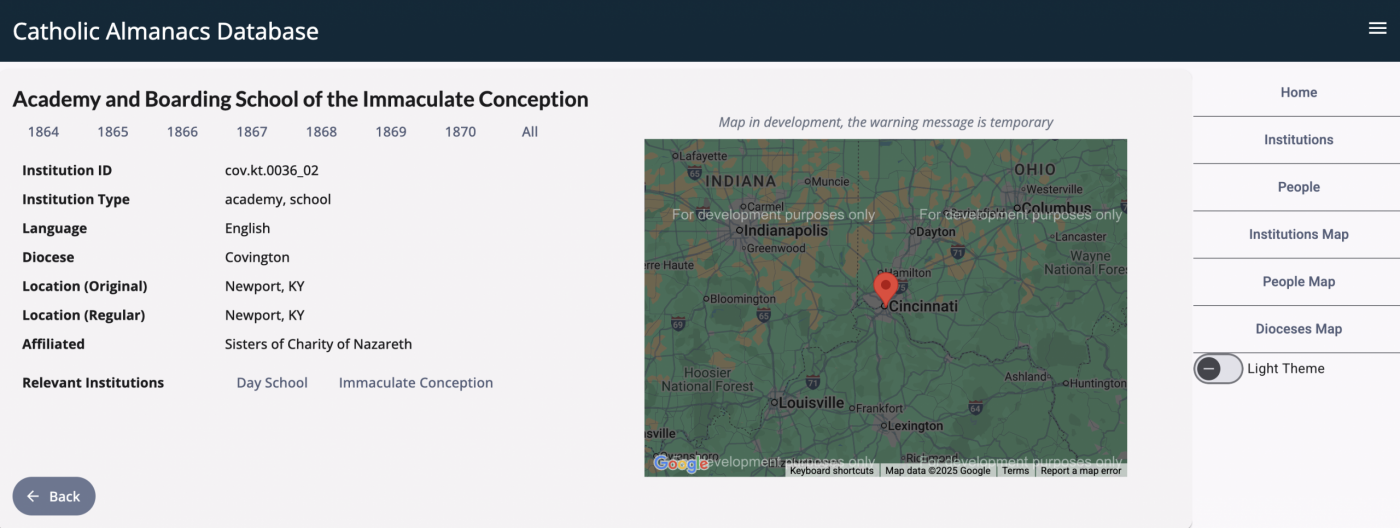
Catholic Almanacs Database currently in development |
| |
|
Yuchen Xiong, currently in her second year of the English MA program, has been working on developing the database to house the Catholic almanac data, which she began in Spring 2025 as part of her capstone project. On the backend, she has improved the table structure to enable complicated queries for religious orders, interrelated institutions in a specific diocese, visiting pastors across various institutions, and more. On the frontend, she designed multiple filter fields and embedded interactive maps that will enable users to view the location of individual institutions and people, as well as search for all institutions, people, and dioceses across the years. |
| |
|
New 3D Printer in the Digital Studio
|
| |
|
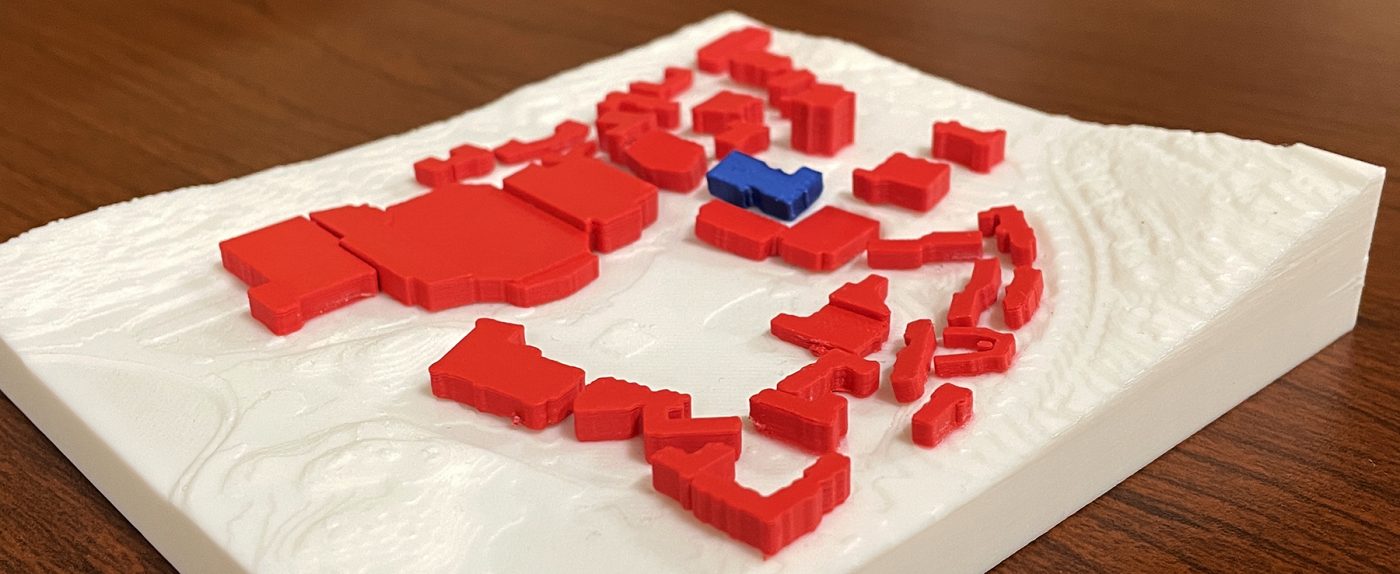
The DSG recently acquired a 3D printer, which is available for use in scholarship-oriented projects, such as printing historical artifacts, creating biological models, and producing 3D visualizations for poster sessions. This semester, an undergraduate math class is using it to print shapes extruded from a 2D profile generated with a mathematical function. These shapes will then be 3D printed to test the buoyancy characteristics of each profile. |
| |
|
A 3D printed model of a BC campus visualization |
| |
|
Please email us for more information. For other 3D printing needs, check out BC's Hatchery. |
| |
|