|
Join us for DH Fest in Spring!
|
| |
|
This January, the Graduate Certificate in Digital Humanities program is celebrating the digital humanities by showcasing ongoing staff, faculty, and student DH projects, including works in progress. The aim is to learn about what our colleagues and students are doing and to foster DH community. Thank you to the Institute for Liberal Arts for their support! |
| |
|
Please contact us if you would like to showcase your work. (We'd love to see it!)
- When: January 23rd at 12 pm
- Where: History Department lobby, Stokes Hall South, 3rd Floor
|
| |
|
Yrvicca Paul, Messina Intern and Rock Star
|
| |
|
We were fortunate to welcome Yrvicca Paul, an outstanding second-year student from Messina College majoring in Applied Psychology and Human Development, as our Digital Scholarship Group intern this fall. Yrvicca contributed to data entry, reconciliation, and visualization for the Catholic Almanacs Project and our nursing school ledgerbook collaboration with Burns. She identified individuals across both sources and resolved issues spanning hundreds of spreadsheets. We benefited enormously from her keen attention to detail and her remarkable ability to navigate the finicky challenges of historical data. We will truly miss you, Yrvicca! |
| |
|
Student-Led Historical Nursing Data Project
|
| |
|
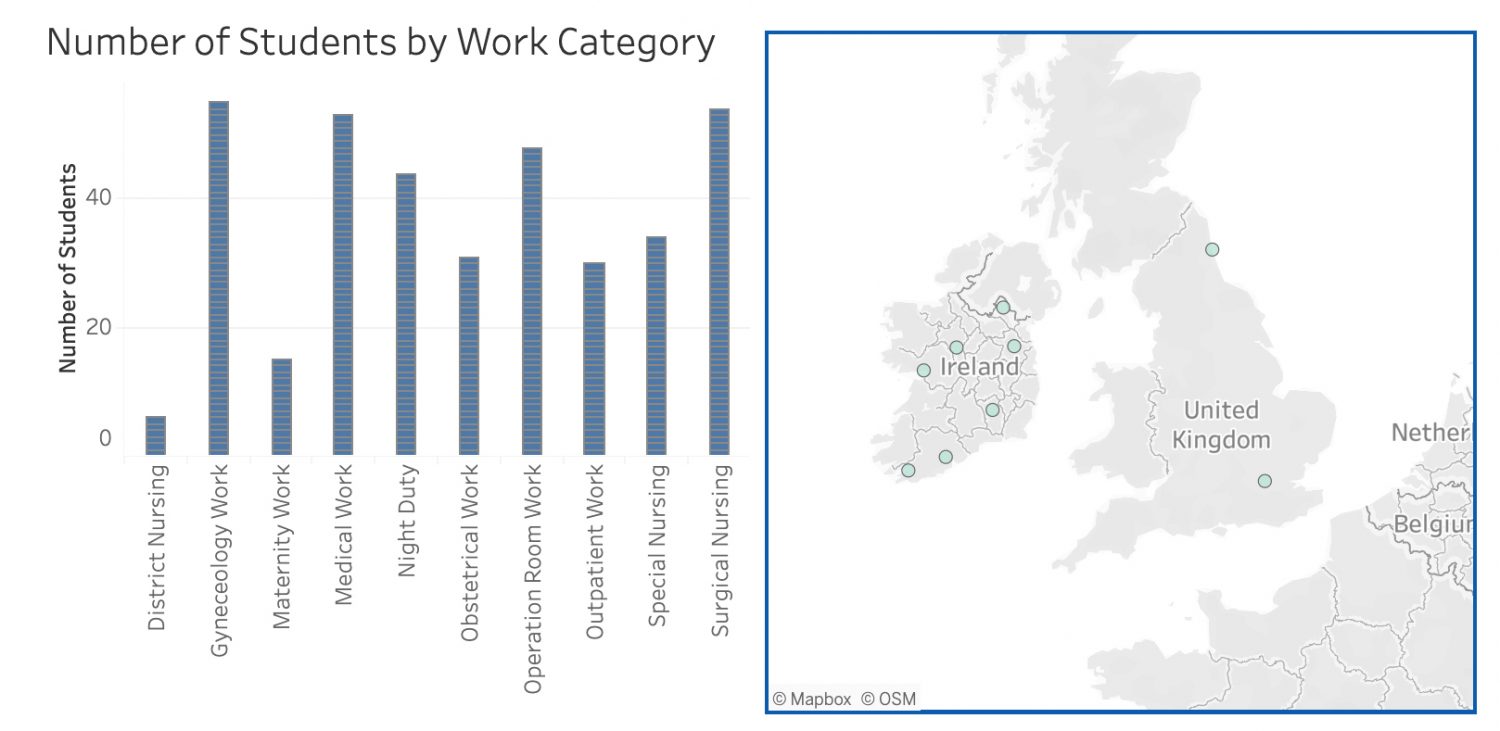
Faris Lahham, a sophomore working in the Digital Studio, expanded the St. Elizabeth’s Hospital School of Nursing Ledgers, 1895–1917 project begun by summer ILA interns, Munir Paviwala and Duygun Rubin. Munir and Duygun initiated the project by designing the data model and beginning the data entry process. Faris carried this work forward, continuing the data entry and developing visualizations of the first half of the ledgers. Together with Joanna, Data Services Librarian, Faris then presented these visualizations to nursing PhD students at an event at the Burns Library, demonstrating how unexpected resources can illuminate their research. |
| |
|
Two of Faris's visualizations of data from the nursing ledgers, showing the specialities of nursing students and the place of origin of some immigrant students. |
| | |
|
Incorporating AI into Research, A Political Science Example
|
| |
|
This semester, Joanna collaborated with Dr. Lauren Honig, associate professor of Political Science, on a project that demonstrates how AI methodologies, such as machine learning and language-learning models, can be incorporated into research. The project, which examines the formation and activities of self-defense groups in Burkina Faso, began as an effort to replicate a collection of newspaper articles for qualitative coding. To make the work scalable, Joanna is training a machine learning model to classify types of self-defense group activities in the articles using a supervised learning approach with a labeled dataset, leveraging the open-source French large language model CamemBERT.
Another key aspect of the project was the data collection component. Together with Sophie Leveque, Liaison Librarian for Economics, Political Science, and International Studies, and Lynette Vargas, Scholarly Resources Licensing Librarian, Joanna identified how to conduct large-scale data collection and text mining within the parameters of license agreements for library newspaper databases. This is no small task! |
| |
|
Women & Blues and Music & Social Justice
|
| |
|
We once again had the pleasure of collaborating with Professor Shannon Jacob on her Women & Blues and Music & Social Justice courses. This time, Ashlyn and Melanie guided students through a website creation project that asked them to draw connections across course content, integrate multimedia elements such as videos and maps, and present their writing to a public audience. Some of the projects will be featured on our undergraduate projects page in the near future. |
| |
|
Introduction to Digital Humanities
|
| |
|
This fall, the DSG continued its work with the Graduate Certificate in Digital Humanities program, collaborating once again with instructor Angie Pacone, Assistant Professor of History, on the introduction to DH course. This foundational class introduces students—most of them new to DH—to core concepts and methodologies. We were delighted with the students’ engagement and excited to see their final projects, which range considerably in methodology and subject matter. One student is constructing a 3D model of Soviet-era housing to explore how spatial development, shaped by national policy, influenced residents’ lived experiences, while another is conducting a textual analysis of the rhetoric and sentiment surrounding trans people in conservative media. Text encoding has been especially popular this year, with two students creating XML/TEI-encoded digital editions: one juxtaposes sections from two translations of The Odyssey with Madeline Miller’s Circe, while the other draws on chapters of Pauline Hopkins’s Of One Blood serialized in The Colored American Magazine. (Read More) |
| | |
|
Lots and Lots Data Instruction
|
| |
|
Joanna provided a wide range of data instruction this semester, teaching twenty-nine sessions in total. The sessions took many forms, some deliberately conducted without computers to foster engagement and reduce barriers for students less familiar with the concepts being introduced.
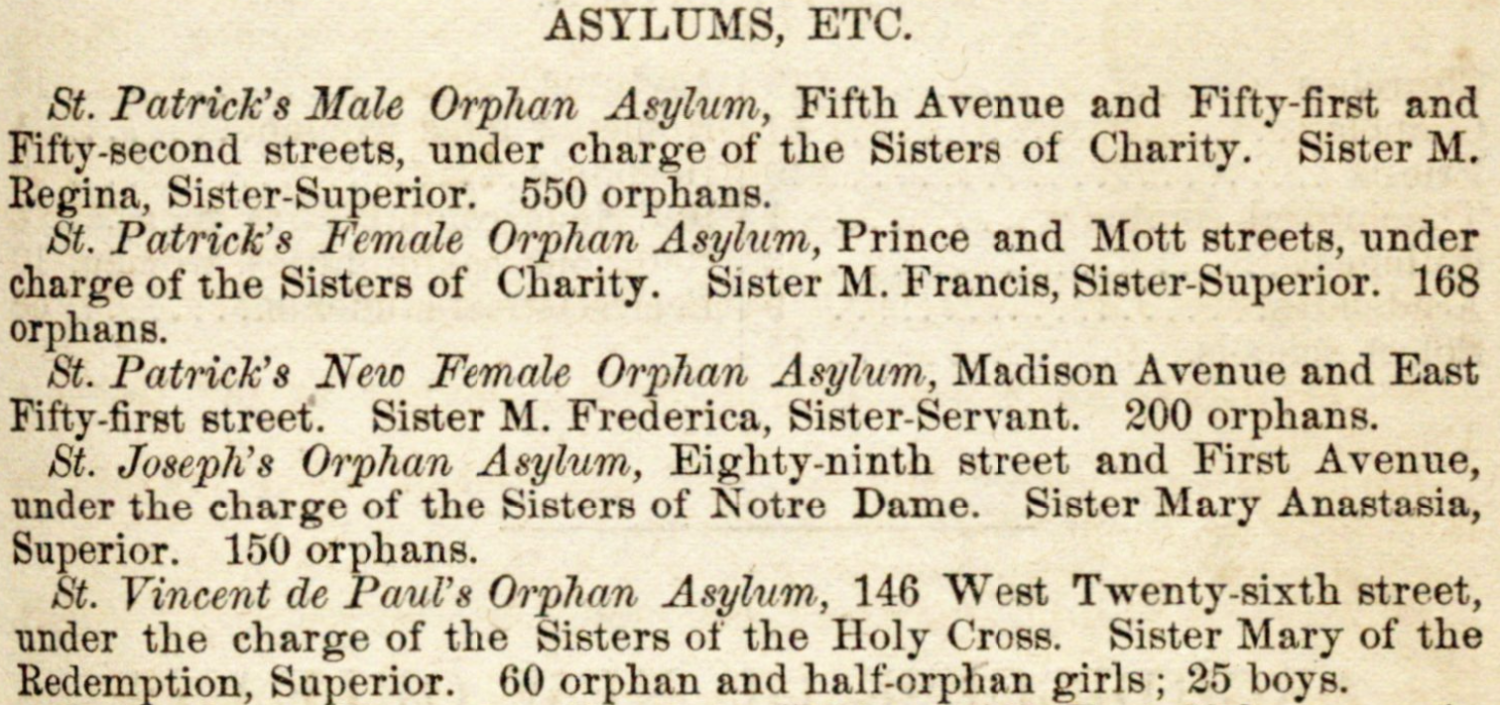
In Professor Emily Prud'hommeaux’s Data Science Capstone, she had students work in project teams to assemble a coherent file-management scheme from a pile of assorted files and folders; in Professor Kristin Lunz Trujillo’s Media and Politics course, she had students examine visualizations created from the same dataset to see how choices in data visualization can shift interpretation; and in Professor Angie Pacone’s Introduction to the Digital Humanities graduate class, she had students work in pairs with “messy data” from Catholic almanacs to learn how unstructured information can be transformed into a coherent data model. |
| | |
|
An example of the messy Catholic almanacs data that Joanna had students structure. |
| | |
|
Catholic Almanacs Project Update
|
| |
|
Our students continue to encode the names, locations, and leaders of the institutions listed in a series of Catholic almanacs for our ongoing Almanacs project. Graduate student Justin Brown-Ramsey and undergraduate Kate Goldfarb are proofing the encoding of institutions from the start of the almanacs run (1833-38), while undergraduates Bhakti Patel, Kaitlyn Bell, Louisa Bagot, Curran Schestag, Lucy DeMeo, and Leo King are working on 1864 to 1870. The students have only a handful of dioceses left–in just 1864, '65, and '66–before both of those chunks are complete and the teams can continue their race to the middle.
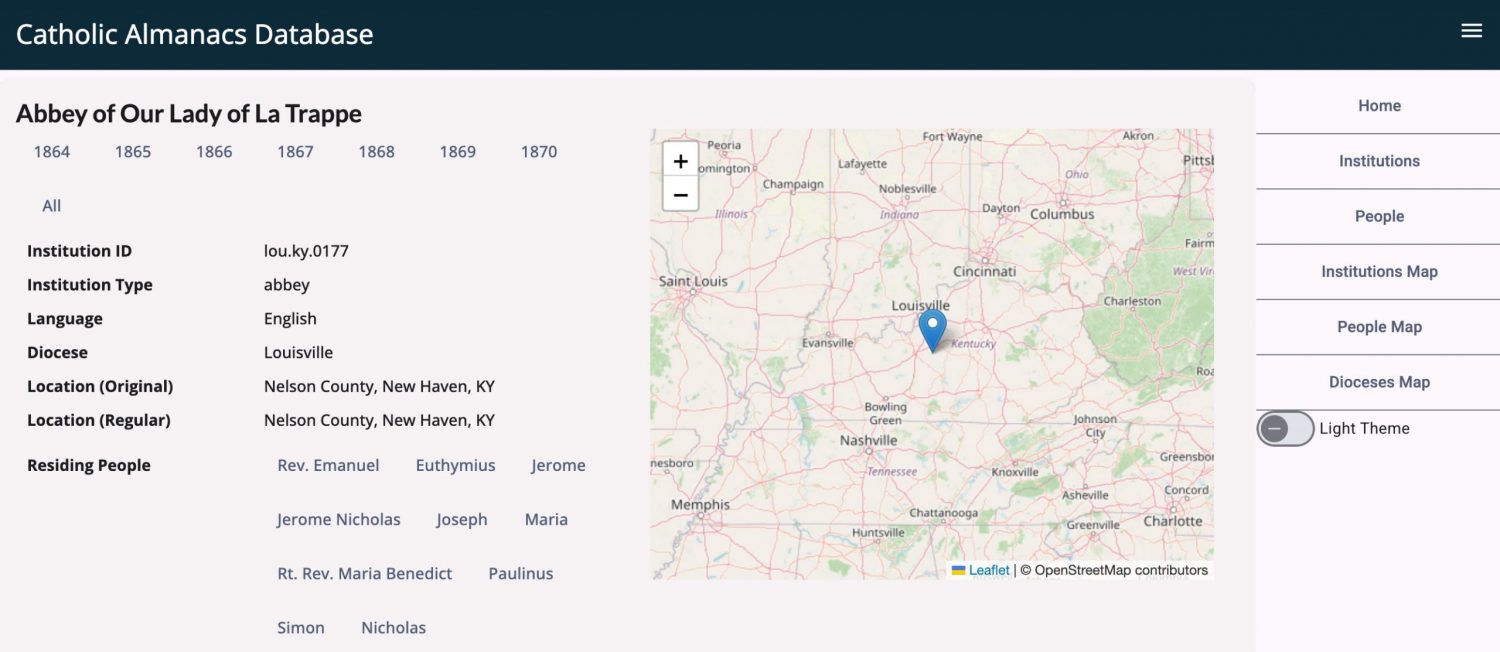
Most importantly, the database for searching all of this information now has a stable development version that students use and test daily. Yuchen Xiong has built this database over the last nine months under the tutelage of Dave, and its production version will be ready to soft launch by March 2026. |
| | |
|
The beta version of the Catholic Almanacs database, built by Yuchen Xiong. |
| |
|
This ongoing 3D modeling and database project reached a major milestone last year with the successful scanning, uploading, and annotation of the full BC ornithological collection—over three dozen birds. The ultimate goal is ambitious: to build a database encompassing every bird species endemic to Massachusetts. To support this undertaking, the project was recently awarded an ATIG grant, enabling Professor Jeff DaCosta and Antonio to plan the next phase during the semester. In partnership with the Libraries, the project purchased a metrology-grade laser scanner capable of capturing the finest details of avian morphology. Next semester, undergraduate research assistants will begin scanning an expanded set of specimens as the team launches a collaboration with Harvard University to digitize their ornithological collection. |
| | |
|
Jesuit Catalogs Database Update
|
| |
|
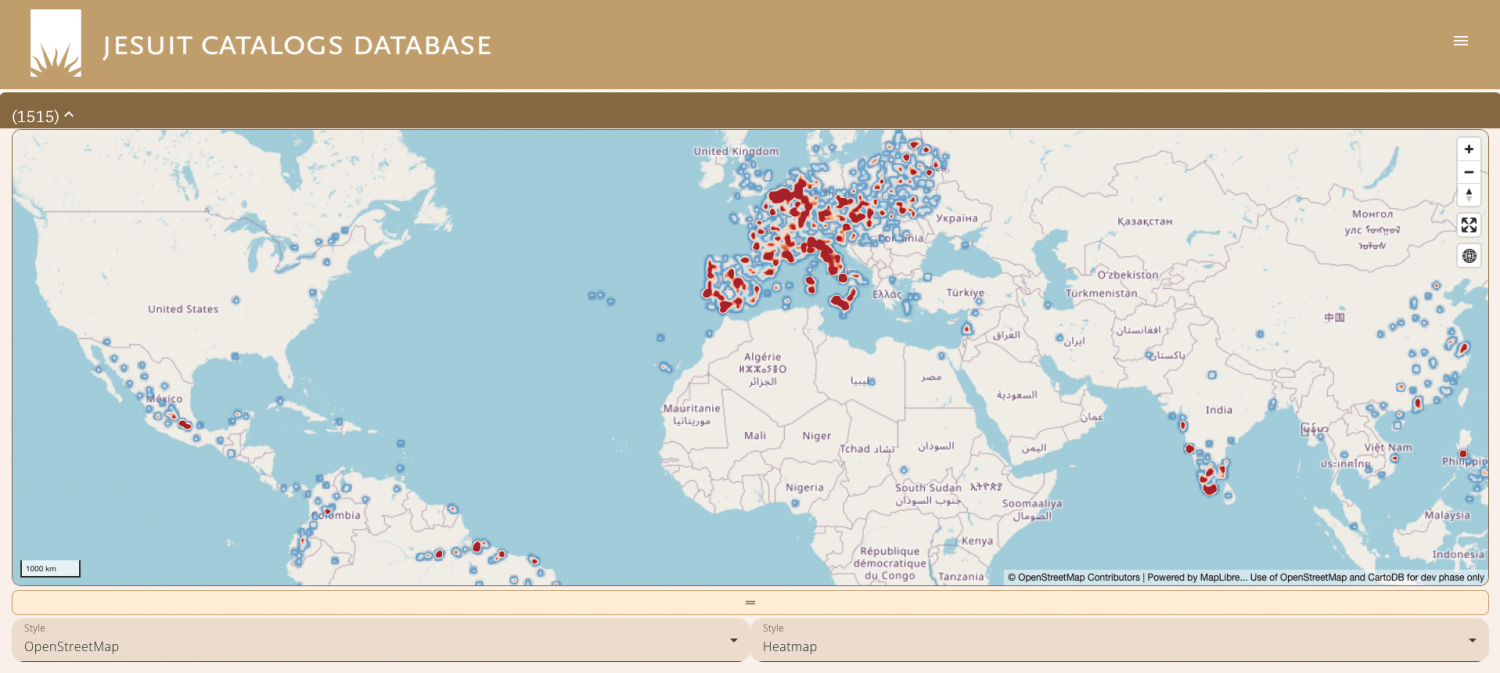
With Dave's custom app written and servers all set up, the Jesuit Catalogs Database project is preparing for its launch and initial data entry phase by international research teams. The first group to conduct data entry, affiliated with the University of Vienna, will shortly begin work on the economic records of thousands of Jesuit communities spanning centuries. The project’s first year will focus on expanding the data entry workflow and seeing more teams of researchers start using the platform to enter data. Eventually, the site will expand the number of visualization and data analysis tools available to users. |
| | |
|
The map view in the Jesuit Catalogs app allows for geospatial visualization of the data being entered. |
| |
|
Introduction to Website Creation Module
|
| |
|
This semester, Melanie designed and released a Canvas module introducing students to the fundamentals of website creation—site structure, content organization, visual design, and accessibility. Instructions for Google Sites are also included, and other platforms can be put in their place.
It can be accessed with this link or by searching for "Introduction to Website Creation" in Canvas Commons. We encourage faculty to have their students complete the feedback form so we can make improvements. |
| |
|